Postmarked Fever: The Paper Trail That Kept American Bee Gees Fans in Step
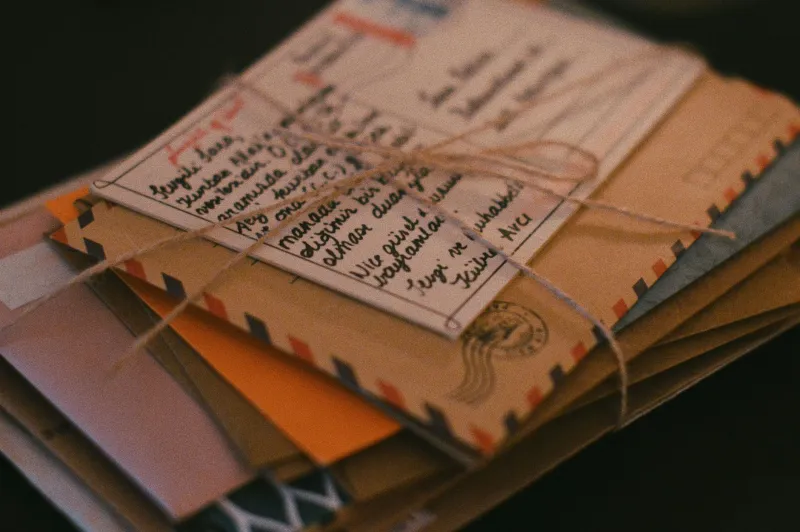
There was a particular sound to it. Not a falsetto, not a hi-hat — a screen door creaking open, a hand reaching into a metal box, and the soft shuffle of an envelope that had been somewhere. Maybe it came from a fan-club address in Ohio. Maybe from a stranger in Burbank who owed you a letter. Either way, it had traveled, and it was yours.
For American Bee Gees fans in the 1970s and '80s, the mailbox was the internet. It was slow, it cost a stamp, and it worked beautifully.
The Ritual of the Return Envelope
If you joined a fan club in the Fever era, you learned the vocabulary fast. The self-addressed stamped envelope — the SASE, pronounced like a word, not an acronym — was the currency of the whole operation. You wanted a photo? You sent an SASE. You wanted the current newsletter, a membership card, a lyric sheet, a schedule of the brothers' upcoming television appearances? You sent an SASE, sometimes two, sometimes folded inside a hand-decorated envelope because you were fourteen and you wanted whoever opened it to know you cared.
Run entirely by volunteers, most clubs operated out of dens, kitchen tables, and dorm rooms. A club president in New Jersey might type up the newsletter on a machine that smelled like ribbon and correction fluid, run off forty copies at the public library, staple them by hand, and drive the whole stack to the post office on a Saturday morning. Nobody was paying her. Nobody had to explain why she did it.
The content was gloriously specific: a rumored tour date in Cleveland, a trade list for cassette copies of older albums, a note that a certain magazine had a two-page spread on page thirty-one, and an apology because the club's supply of 8x10 glossies had run out until October.
What a Newsletter Actually Felt Like
People talk about print as if it were only a delivery system. Anyone who held one of those newsletters knows better. The paper mattered. Mimeograph ink had a smell — faintly sweet, like the inside of a school office — and a texture, the letters slightly bled at the edges. Photocopied pages came out gray and ghostly. Somebody's typewriter dropped its lowercase "e" below the baseline for the entire issue, and nobody minded, because it was ours.
Corrections ran in the next issue with a cheerful shrug. Editors thanked members by first name and last initial, shout-outs that functioned as a small civic honor: thanks to Donna R. in Sacramento for the clippings. That was a form of celebrity no chart could measure.
And the photos. Before a fan could pull up a thousand images in ten seconds, a single glossy — Barry in a white suit, the three of them squinting into a flash at some airport — was an object of genuine study. Fans taped them inside locker doors in Illinois and propped them on dorm desks in Texas. The scarcity made the looking sharper.
The Pen-Pal Column Was the First Comment Section
Maybe the most underrated invention of the fan-club era was the pen-pal list. Usually a few dozen lines tucked near the back of the newsletter: name, age, city, what you were looking for, what you had to trade. Wanted: someone to discuss the harmonies on "How Deep Is Your Love" without being told to calm down.
That column did what social platforms would later do — only with more patience and better handwriting. It connected a kid in a small town, the only Bee Gees fan in her high school, to somebody four states away who also had the albums alphabetized and a strong opinion about the B-sides. Letters went back and forth for years. People sent birthday cards. They sent mixtapes with hand-lettered index cards. Some of them are still friends today, four decades on, and they will tell you the friendship was built entirely on paper.
Meet Me at the Roller Rink: When Paper Friendships Went Three-Dimensional
Eventually the paper had to become a room. Fan-club meetups were modest affairs: a rented hall, a few folding tables, a record player somebody's older brother operated, and a whole afternoon of songs. Sometimes it was a roller rink on a Sunday, because where else were you going to hear the full "Night Fever" twelve-inch while gliding backwards?
There were swap meets for duplicate singles, taped copies of TV specials traded under the table like contraband, and long debates about which album side was the most underrated. Local record-store bulletin boards carried the flyers, stapled corner flapping. If you were the person who organized it, you made a sign, you brought a cooler, and you hoped eleven people would show up. Usually fourteen did.
The Lean Years and the Loyalty Test
The Fever boom faded. Radio moved on, the culture got snarky about disco, and the big fan-club mailings shrank. But here is where the correspondents proved what the whole thing had actually been about. They kept mailing.
In the decade between the brothers' late-'70s peak and their late-'80s return to the American charts, the newsletters got thinner but more personal. Editors wrote longer letters. Members hunted down import singles and rarities with the patience of archivists. When the group came back into the spotlight — and later, when the tributes and retrospectives arrived — those same fans were the institutional memory, the ones who could tell you which night in which city a certain song was performed, and who had the ticket stub to prove it.
That is the quiet heroism of a fan club. It is not glamorous work. It is stamps and staples and the faithfulness to keep sending things when nobody is watching.
What the Correspondents Taught Us
Today the official community lives on screens, and that is a fine thing — faster, wider, easier for a fan in Nebraska to find a friend in Florida. But the paper generation left instructions worth keeping.
They remind us that fandom is a form of care — that someone has to do the unglamorous labor of gathering, typing, and sending. They remind us that specificity beats scale: one thoughtful letter to one person lands harder than a thousand throwaway posts. And they remind us that the music on those records, all these years later, still rewards the listener who leans in closely, studies the harmonies, and wants to talk about it with somebody who gets it.
So here is a small tribute to the club presidents at the kitchen table, the pen pals with the good handwriting, the editors who thanked Donna R. in Sacramento by name. You kept the correspondence alive, one envelope at a time. The brothers gave us the songs. You made sure we all had somebody to share them with.